Second Order Band Pass Filter
Second order band pass filter
Second-Order Active High Pass Filter: The second-order filters have two reactive components; in this case, it is capacitors. These second-order filters are preferred over the first order due to its high roll-off rate. It has the roll-off rate of 40dB/Decade or 12dB/octave providing more steeper gain slope.
What makes a filter second order?
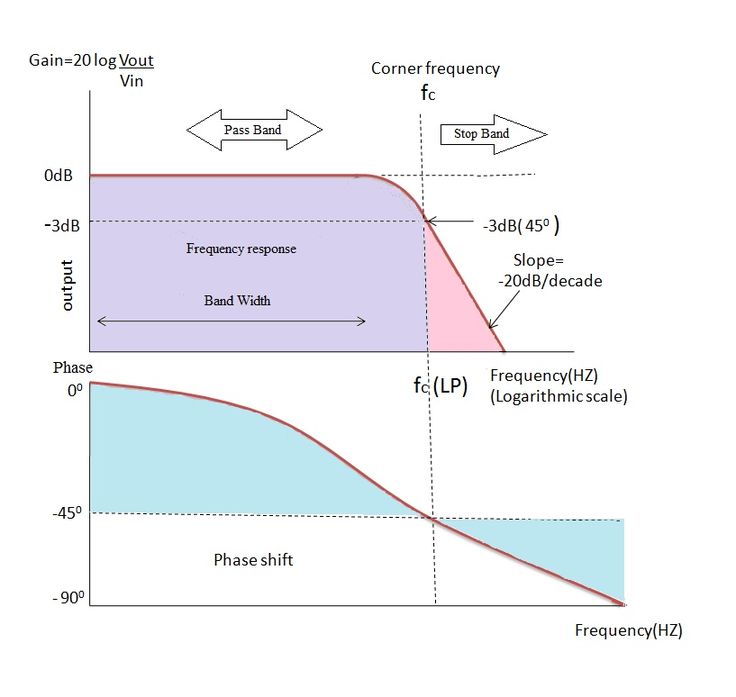
The main difference between a 1st and 2nd order low pass filter is that the stop band roll-off will be twice the 1st order filters at 40dB/decade (12dB/octave) as the operating frequency increases above the cut-off frequency ƒc, point as shown.
What are the types of band pass filters?
A band-pass filter can be characterized by its Q factor. The Q-factor is the reciprocal of the fractional bandwidth. A high-Q filter will have a narrow passband and a low-Q filter will have a wide passband. These are respectively referred to as narrow-band and wide-band filters.
What is the difference between first order high pass filter and second order high pass filter?
The frequency response of the second order high pass filter is identical to that of the first order type except that the stop band roll-off will be twice the first order filters at 40 dB / Decade.
What is second order active low pass filter?
Second Order Active Low Pass Filter Just by adding an additional RC circuit to the first order low pass filter the circuit behaves as a second order filter. The second order filter circuit is shown above. The gain of the above circuit is Amax = 1 + (R2/R1)
How do I create a 2nd order low pass filter?
The second order low pass RC filter can be obtained simply by adding one more stage to the first order low pass filter. This filter gives a slope of -40dB/decade or -12dB/octave and a fourth order filter gives a slope of -80dB/octave and so on.
What is the difference between 1st order and 2nd order filter?
The main difference between a 1st and 2nd order low pass filter is that the stop band roll-off will be twice the 1st order filters. ➢ In the second order low pass filter configuration and the second order high pass filter configuration, the only thing that has changed is the position of the resistors and capacitors.
Why is a second order filter better than a first-order filter?
2nd order filter is more accurate than 1st order because output of 2nd order filter is more straight and less fluctuating( fluctuation around 0.1). The main difference between the 1st and 2nd order filter is,the number of active components(capacitor or Inductor) used in it.
What is first-order and second order Butterworth filter?
A first-order filter's response rolls off at −6 dB per octave (−20 dB per decade) (all first-order lowpass filters have the same normalized frequency response). A second-order filter decreases at −12 dB per octave, a third-order at −18 dB and so on.
Why bandpass filter is used?
Bandpass filters are used primarily in wireless transmitters and receivers. The main function of such a filter in a transmitter is to limit the bandwidth of the output signal to the minimum necessary to convey data at the desired speed and in the desired form.
How do bandpass filters work?
Bandpass filters work by absorbing or reflecting unwanted wavelengths, and only transmitting the desirable parts of the visible light spectrum. They can be defined using a number of characteristics: Blocking Level: How effectively the unwanted wavelengths are eliminated.
What are the types of filters?
Four Major Types of Filters The four primary types of filters include the low-pass filter, the high-pass filter, the band-pass filter, and the notch filter (or the band-reject or band-stop filter).
What is first order high pass filter?
A first-order (single-pole) Active High Pass Filter as its name implies, attenuates low frequencies and passes high frequency signals. It consists simply of a passive filter section followed by a non-inverting operational amplifier.
What is difference between low pass and high pass filters?
Low pass filter: Low pass filter is the type of frequency domain filter that is used for smoothing the image. It attenuates the high frequency components and preserves the low frequency components. High pass filter: High pass filter is the type of frequency domain filter that is used for sharpening the image.
What is first order low pass filter?
A first-order active low pass filter is a simplistic filter that is composed of only one reactive component Capacitor accompanying with an active component Op-Amp. A resistor is utilized with the capacitor or inductor to form RC or RL low pass filter respectively.
What is the slope of the 2nd order Butterworth low pass filter?
The low-pass filter of the 2nd order contains two reactive elements (capacitor and coil), so its transmission amplitudefrequency characteristics shows a slope of -40 dB/decade (Figure 4).
Why higher-order filters are better?
High-order filters are used because they have the ability to roll off gain after the bandwidth at a sharper rate than low-order filters. The attenuation of a filter above the bandwidth grows proportionally to the number of poles. When rapid attenuation is required, higher-order filters are often employed.
What is first-order filter?
The order of a filter is determined by the form of the differential equation governing the filter's behaviour. The simplest type of filter, with the simplest equation, is called a first-order filter.
What is the cutoff frequency of a second order low pass filter?
Low Pass Filter Summary So to summarize, the Low Pass Filter has a constant output voltage from D.C. (0Hz), up to a specified Cut-off frequency, ( ƒC ) point. This cut-off frequency point is 0.707 or -3dB ( dB = –20log*VOUT/IN ) of the voltage gain allowed to pass.
How is bandpass filter bandwidth calculated?
The bandwidth of the filter is therefore the difference between these upper and lower -3dB points. For example, suppose we have a band pass filter whose -3dB cut-off points are set at 200Hz and 600Hz. Then the bandwidth of the filter would be given as: Bandwidth (BW) = 600 – 200 = 400Hz.
15 Second order band pass filter Images
Passive Low Pass RC Filters Filters Passive Electronics

Band Pass Filter Circuit Electronic circuit design Circuit diagram

Band Stop Filter Circuit design Filters Circuit

LPF LOW PASS FILTER 30 MHz for SDR RADIO HF SSB LSB USB CW AM ANTENNA

1133 Me gusta 4 comentarios Solve Physics solvephysics en

OnAxis 6th Order Parallel Bandpass Enclosure Calculator Angled View

Active band pass filter based on LM358 Filters Active Band

8th Order Bandpass Explained Part 1 YouTube Explained Positive

4th order bandpass calculator With subwoofer box design example

Multipurpose a control circuit low pass high pass Filter sections 30

Pin on Electrical Technology

In this tutorial we will learn about a special Band Stop Filter is

The bandpass subwoofer box has improved efficiency over bass reflex

Design LowPass HighPass and BandPass Filters in Browser in Minutes

Post a Comment for "Second Order Band Pass Filter"